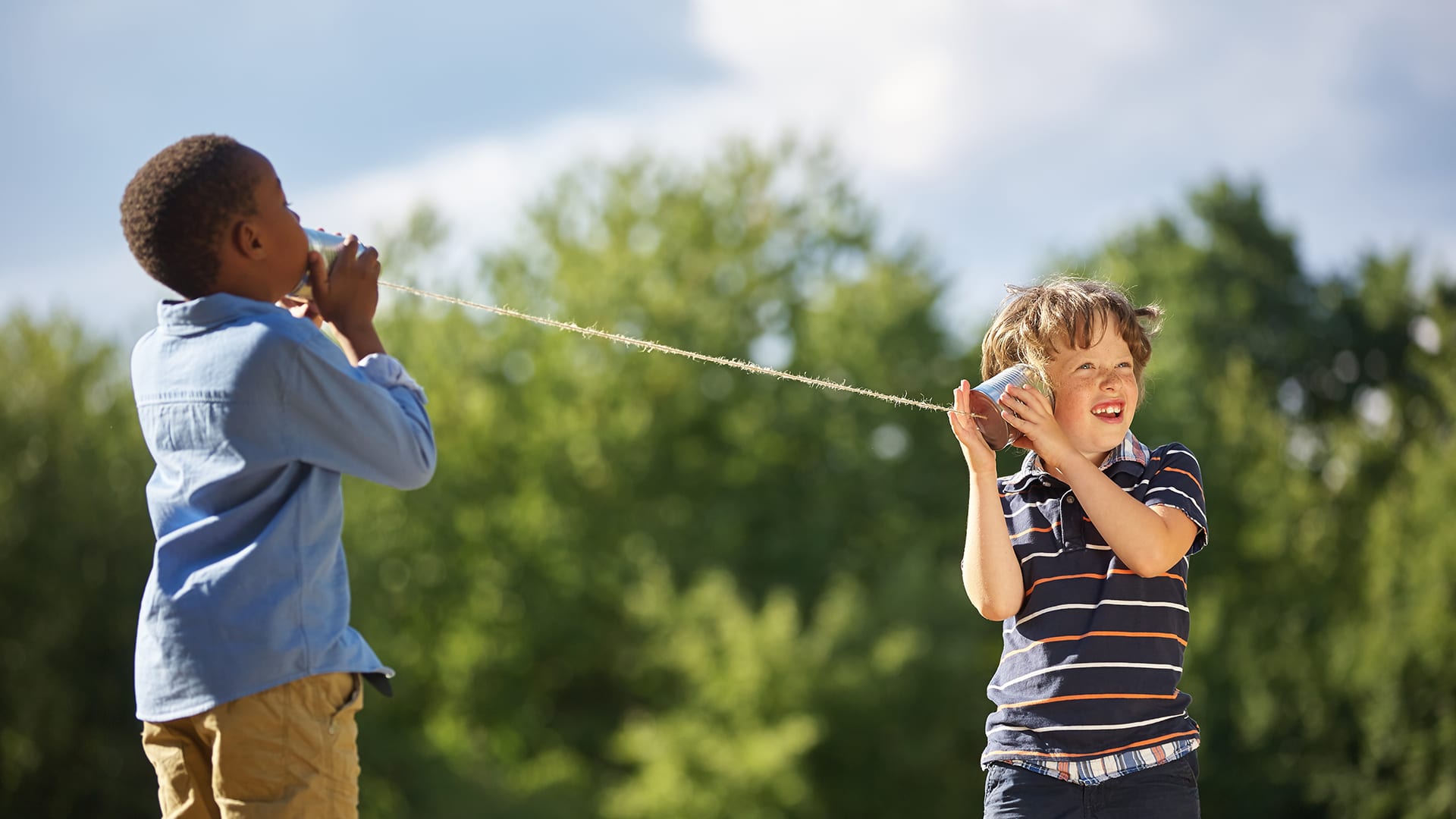
In this unit, students investigate light and sound! They explore how materials vibrate and how vibrating materials can make sounds. They also investigate light and illumination and use those investigations to create simple devices that allow them to communicate across a distance.
In this lesson, students investigate vibrations as a source of sound effects for movies. In the activity, Be a Sound Effects Artist, students use their hands and feet to create a "rainstorm," and then use rulers to create a “boing” sound for a cartoon bouncy ball.
During the rainstorm activity, you may want a way to make thunder. It’s fun to add the rumble and crash of thunder and is another visible demonstration of vibration creating sound. Watch this video to see how to use the optional items to make thunder.
If you decide to add thunder to your rainstorm, decide who will be the Thunder Master, the maker of thunder. We suggest you let this person experiment before class so that they can create a great thunder sound for your rainstorm.
Read-Along Lesson 2: Sounds & Vibrations
In this Read-Along lesson, Lin explores the sounds made by different kinds of instruments, and discovers what happens when vibrations start—and when they stop. The lesson includes a short exercise where students experiment with a piece of paper to make the connection between vibrations and sound. You can extend the lesson with the optional activity, Head Harp, where students make simple musical instruments using only their heads and string.
We recommend a simple sound experiment from San Francisco's Exploratorium that lets your students experiment with sound—without making a lot of noise.
Follow the instructions here. Encourage students to experiment to figure out how to change the sound. They can make it higher by pulling the string tighter and lower by loosening the string. Each student will need a piece of string or yarn that’s at least 3 feet (1 meter) long. Students can work on their own, but we suggest students work in pairs so they can discuss their ideas with one another.
Lesson 3: Light, Materials, Transparent & Opaque
In this lesson, students consider materials from the perspective of how much light they let through. In the activity, Paper Stained Glass, they use these materials to create a work of art.
For the main activity, Paper Stained Glass, you will need windows so you can display students' artwork.
Prepare Materials for a Short Sorting Exercise
This lesson includes a “Seeing & Sorting” exercise to get students thinking about light and materials before they make their Paper Stained Glass. We recommend you prepare a variety of opaque, translucent, and transparent materials and divide your class into groups of 2 to 4. Cut materials up so that each group has samples of all the materials. Materials do not have to be exactly the same size or shape. When you are cutting up flat materials, we suggest making squares measuring about 3” x 3” (about 8 cm x 8 cm).
Prepare Materials for Paper Stained Glass
Using scissors or a paper cutter, cut tissue paper into small squares and long strips. Watch this video to see how we did it. Watch this video to see how we prepared Press ‘n Seal squares.

Read-Along Lesson 4: Light & Illumination
In this Read-Along lesson, Santiago visits a cave and discovers that when it's dark (really dark!) he can't see anything. The lesson includes a short exercise where students find the sources of light around them. You can extend the lesson with the optional activity, Dark Box, where students experience what it's like to try to see in the dark.
We recommend making enough Dark Boxes prior to class so that students can work in pairs. If you only have enough materials to make one or two Dark Boxes, you can use this experiment as an activity station.
As an alternative to making Dark Boxes with cardstock, you can also simply use a shoebox (or similar box with a lid). All you have to do is use a sharp knife to cut a 1-inch square on one end of the box that can serve as an eyehole.
Make Your Dark Boxes
If making Dark Boxes from cardstock, watch this video and follow the instructions on the printed Dark Box templates.
Have Students Play “Dark Box”
Have pairs of students cut, fold, and color the Dark Box Messages.
Distribute the “How To Play Dark Box” printout to each pair of students.
Students will take turns placing a message inside the box and try to read the message.
Ask students how much light they need to see the message clearly and if there is anything they can do to let more light into the box. Students will start to notice that they can only read the message once they start to lift the lid of the box to let more light through. (NOTE: If students have difficulty lifting the box lid slightly, you can cut a small hole on the top of the lid and have students cover the hole to make it dark, and uncover the hole to let light in.)
Lesson 5: Light, Communication, & Engineering
In this lesson, students practice using light to communicate information. In the activity, Secret Signals, students work in pairs to build a device that solves the problem of communicating over a distance. They send secret messages to one another using light and colored markers.
Preferably 1 red, 1 blue, and 1 green. You can use three other colors, but make sure they are very different from one another. Similar colors (red, pink, and orange) can lead to confusion.
Make sure you have enough space. Pairs of students will need to be at least 5 or 6 feet apart, and have a clear line of sight to each other. Homeschool students working alone will need a partner to do this activity.
You will need to do this activity in the dark with the lights off and curtains drawn.
Classroom Management Tip
Flashlights are very fun, but can be very distracting! We suggest waiting to distribute flashlights to students until Step 6 of the activity.
Read-Along Lesson 6: Lights, Sounds, & Communication
In this Read-Along lesson, Gabrielle sets sail with her aunt—the captain of a tugboat—and discovers how the sights and sounds on the bay can help boats find their way. The lesson includes a short exercise where students get moving by pretending to be boats. You can extend the lesson with the optional activity, Navigating by Sights and Sounds, where students play games to practice listening for sound cues.
We recommend two activities (Red Light/Green Light and Sound Card Challenge) that let students explore their own skills of watching and listening and practice some of the sound words they hear every day.
This episode is locked
Invite 5 or more friends and we'll unlock all previous episodes as a thank you!
Locked
6:10
Why is the sky blue?
Locked
4:41
Why do we call them doughnuts?
Locked
5:16
Could a turtle live outside its shell?
You are using an unsupported browser. For the best experience using Mystery Science,
we recommend upgrading to one of the following browsers: